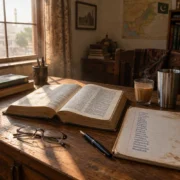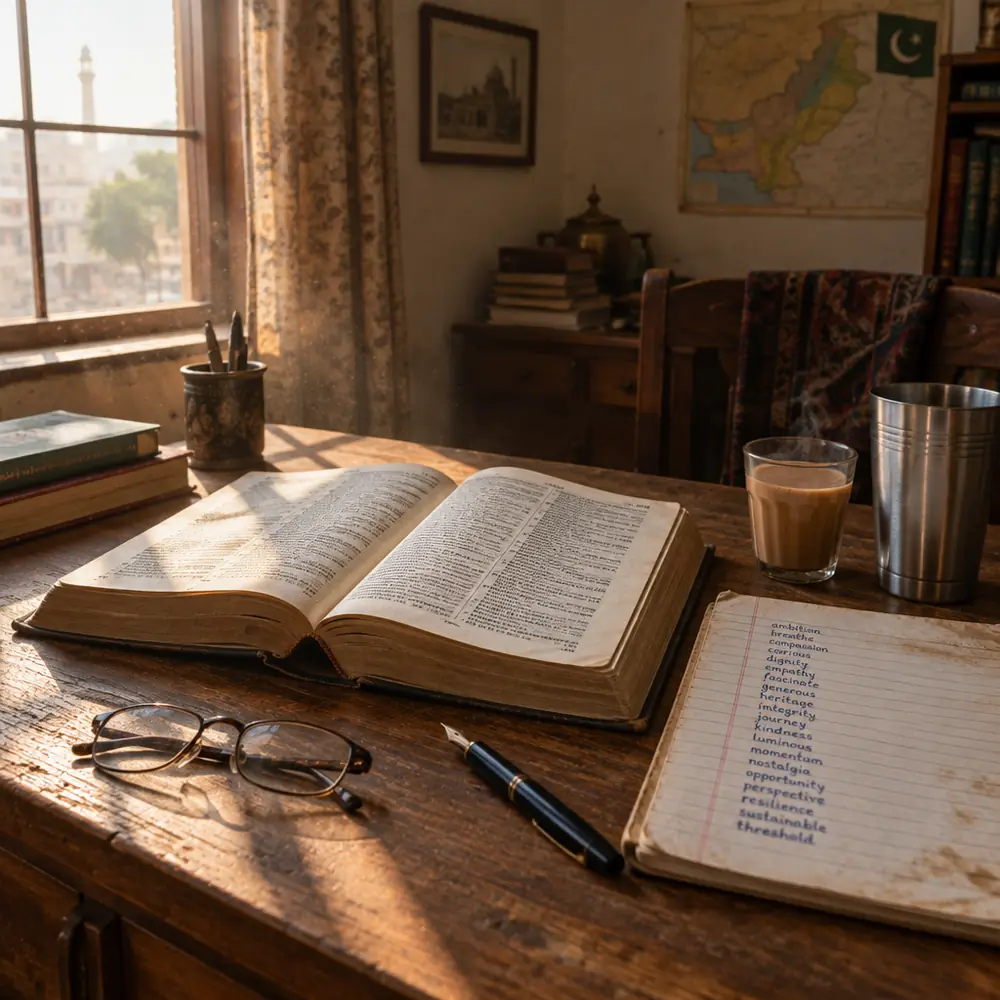
Every traveller who orders a coffee in Lahore or buys a bus ticket in Gilgit ends up using Urdu words without knowing it. English has been borrowing from Urdu and Hindi for four centuries, and the words that stuck are not the grand ones. They are the everyday ones: the shirt you sleep in, the building you stay in, the sauce you spoon onto a samosa. Nine of them follow, each with the route it took into English and where in Pakistan you are most likely to meet it again.
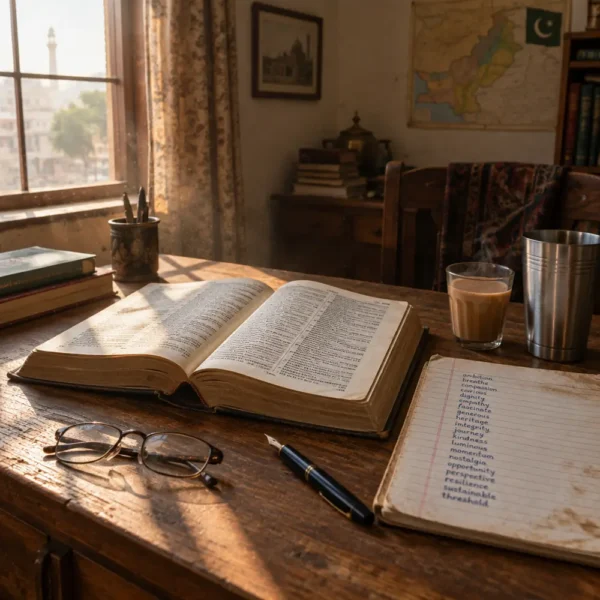
Why English picked up words from Urdu and Hindi
English has never been fussy about where it takes its words from. When sailors, merchants, soldiers and clerks from Britain spent long stretches in the Indian subcontinent, they picked up local vocabulary the way anyone does: by needing a name for something that had no name at home yet. Most of what they heard was Hindustani, the spoken mixture of Hindi and Urdu that ordinary people used across northern India and what is now Pakistan. Urdu itself borrows heavily from Persian and Arabic, so a word that looks Indian in an English dictionary often travelled a much longer road to get there.
The borrowing happened in two moods. Words for food, clothing, money and household objects came in casually, through daily contact at a counter or a kitchen door. Words for landscape and conflict arrived with more weight, usually through reports, surveys and officials writing letters home. Writers of the eighteenth and nineteenth centuries then fixed the spellings, often by ear. That is why English keeps a “shampoo” that nobody in Pakistan pronounces that way, and a “pyjama” with a y in the middle.
The result is a small hidden dictionary inside English. A visitor who knows the Urdu original has an advantage: the word on the label, the menu or the painted signboard stops being foreign, and the country reads a little easier. Our guide to essential Urdu phrases covers the words you will actually need to say; this piece is about the ones you already own.
Shampoo and chutney: words that came through trade
Trade came first. Ports on the west coast dealt with European shipping for centuries, and the words that crossed with cargo were the words for things worth selling.
Shampoo is the strangest of the nine. It comes from chāmpo, an Urdu and Hindi instruction meaning to press, knead or massage, and it entered English as a description of the head massage given during a bath. Travellers brought the habit home, the meaning narrowed to washing hair, and a verb slowly became a noun and then a bottle. In Pakistan the older sense survives: a barber may offer a champi, a head massage, and mean exactly that.
Chutney comes from chatni, in turn from chatna, to taste or lick. It arrived in English as a relish of fruit, vinegar, sugar and spice, and the British table adopted it so completely that the word now sits on supermarket shelves far from Asia. In a Pakistani market the original is a fresh, sharp thing: coriander, mint, green chilli and yoghurt ground together in a stone bowl and served the same morning, the kind of thing our guide to Pakistani street food sends you looking for.
Punch, the drink, is a third. It most likely comes from panch, the word for five, and referred to a drink assembled from five parts. English took the cup and left the number behind.
None of these words were coined in a dictionary. They were coined at a counter, between a buyer who wanted to be understood and a seller who wanted to be paid.
Pyjama, bungalow and verandah: words that arrived with the Raj
The next layer arrived with the Raj, the period of British colonial rule in the Indian subcontinent, and with the households, offices and hill stations it built.
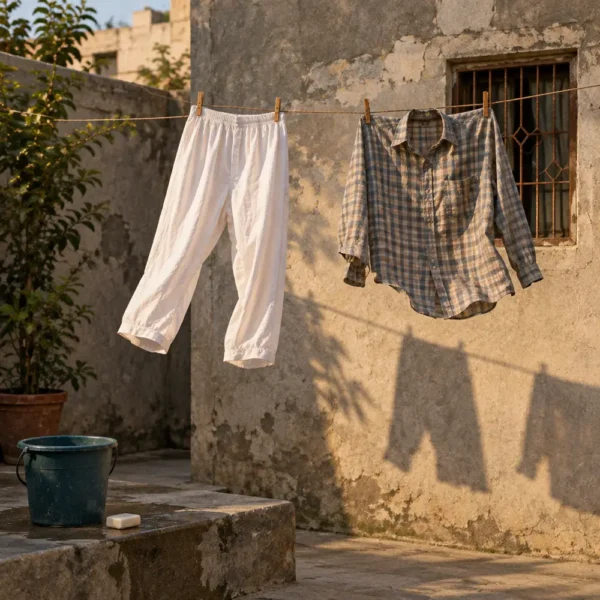
Pyjama is the clearest case. It comes from pāy-jāma, literally leg garment, from pāy, leg, and jāma, clothing. In South Asia it means the loose drawstring trousers worn at home and in bed. English took the trousers, kept the spelling, shifted the pronunciation and eventually applied the word to a two-piece sleeping suit. In Pakistan it still means only the trousers, which surprises visitors who arrive expecting a matching top.
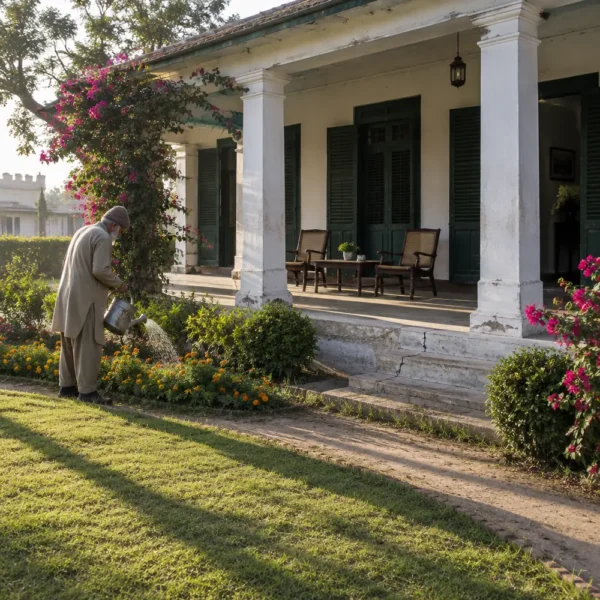
Bungalow comes from bangla, meaning Bengali, and described the single-storey house with a wide, shaded front that the British built for hot weather. The verandah itself is baramdah in Urdu, a roofed open gallery running along the front of a house. Both words describe a response to climate rather than fashion: shade, cross breeze, and a place to sit outside without sitting in the sun. You will see the shape in older Pakistani towns, and a cultural and heritage tour is worth more than a photograph from a car window.
Cummerbund, the wide waist sash worn with formal dress, comes from kamarband, waist band, from kamar, waist, and band, a tie. It was taken from Indian dress and reattached to evening wear, where it now sits at weddings in Karachi and in London with equal ease. Khaki, from khāk, dust, travelled the same road and ended up on soldiers, scouts and half the trousers in the world.
What these words share is that they describe things a hot country needed and a wet one did not: a light trouser, a shaded gallery, a dust-coloured cloth. English did not borrow the ideas so much as the furniture of daily life, and then forgot where the furniture came from. Standing in a bungalow verandah in the late afternoon, with the light going amber and the cane chairs still warm, the borrowing stops being a fact about language and becomes something you can sit in. Our destination guides point to the towns where that architecture is still standing.
Jungle, loot and thug: the words that carried a story with them
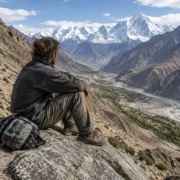
Jungle comes from jangal, which in Urdu means rough, uncultivated ground before it means trees. A patch of scrub behind a village is a jangal; so is a tangle of weeds in a walled garden. English took the word, made it lush and tropical, then used it for anything dense and unordered. Drive out of any Pakistani city and the landscape is closer to the original: thorn, dust, grazing goats.
Loot arrived as a verb in the eighteenth century, during the wars that redrew the map of the subcontinent. Lūṭ means plunder, and English accounts of captured towns used it so often that it stopped needing italics. The garrisons those campaigns left behind still stand, and our guide to the forts of Pakistan covers the ones worth a detour. It keeps its force: a stripped warehouse in Karachi and a cleared shop in Manchester use the same word.
Thug is the darkest of the set. Ṭhag named a robber who preyed on travellers on the roads of central India, and the campaign against such gangs in the 1830s put the word into English newspapers for good. From there it loosened into a general term for a violent criminal. In Urdu it stayed lighter: a ṭhag is a cheat, the man who sells you a fake antique in a bazaar. Nine is a convenience here; English never stopped at a round number.
Khaki and dinghy: words you use without noticing
Khaki entered through uniforms. The word is khāk, dust, and the cloth was dyed the colour of the ground it was worn on, first by irregular corps in the north-west and then by armies everywhere. In Pakistan it is a working colour: police, scouts, schoolboys, the man who fixes the generator.
Dinghy is a boat. Ḍiṅgī is a small rowing boat, and probably reached English through Bengali before spreading to mean any tender bobbing behind a yacht. On the Indus and around Karachi’s creeks the original still does the work: shallow hull, a pair of oars, a load of vegetables in the middle.
Hearing them in Pakistan, and what to say back
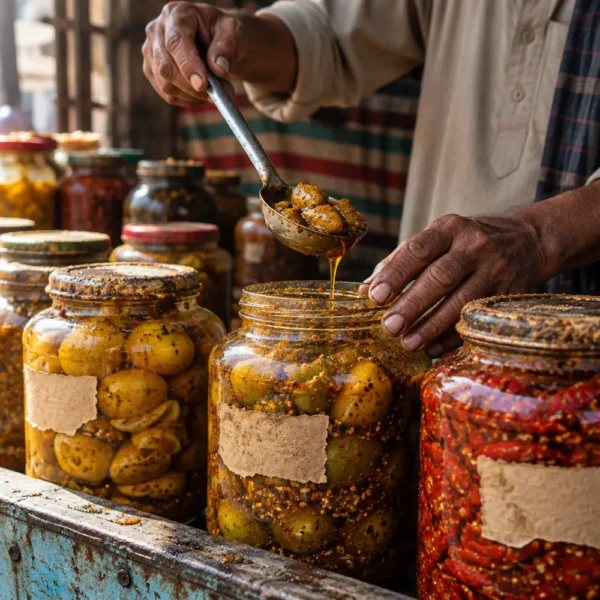
Walk through any bazaar and the words are already there, painted on boards and printed on packets. A sign painter in Lahore letters a shop name in Urdu and puts the English underneath, because both sell. A chemist stocks shampoo labelled in English, while a barber offers the champi that gave the word its start. Menus list chutney beside raita. A tailor sells pāy-jāma by the drawer, and a property agent advertises a bungalow with a verandah: exactly the building the British built and the Pakistanis kept. What happens once you are invited inside is its own vocabulary, and our guide to Pakistani hospitality covers it.
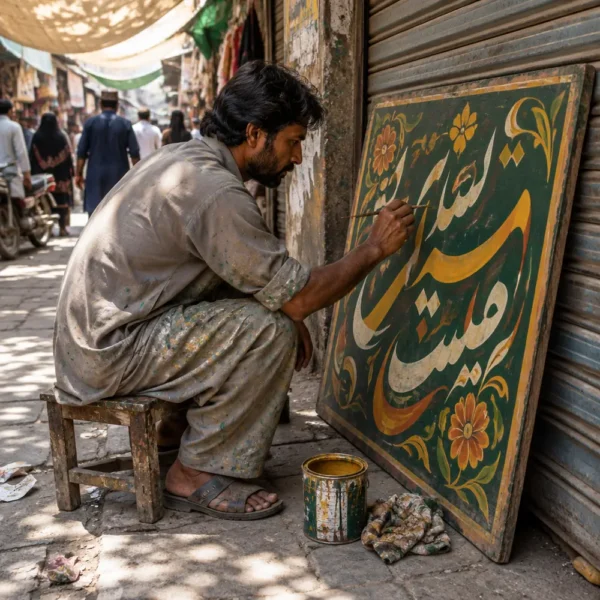
What to say back is simple: use the Urdu and watch faces change. Ask for chatni rather than chutney, say jangal when you mean the scrub outside town, and a shopkeeper will meet you halfway. For the words you actually need, our essential Urdu phrases guide picks up where this list stops, and our city guides cover the bazaars where these words are still in daily use.
These words are not museum curiosities; they are working vocabulary in both languages. If you would like a route that puts you in those bazaars and courtyards instead of driving past them, browse our scheduled tours or talk to our team and we will build the trip around the words you want to hear.
Frequently asked questions
Is “pyjama” an Urdu word?
Yes. English took it from pāy-jāma, leg garment, from pāy, leg, and jāma, clothing. In Pakistan it means only the trousers; English added the top.
Why does English have so many words from Urdu and Hindi?
Because British traders, soldiers and officials spent four centuries in the subcontinent and needed names for things they had no word for. Most of what they heard was Hindustani, the everyday mix of Hindi and Urdu.
What did “shampoo” originally mean?
It comes from chāmpo, to press or knead, and first described the head massage given during a bath. English narrowed the meaning to washing hair and turned the verb into the bottle.
Is it rude to call someone a thug in Pakistan?
The Urdu ṭhag is lighter than the English: a cheat or a swindler, the sort of person who overcharges a visitor, closer to “con man” than to “violent criminal”.
How many English words come from Hindi and Urdu?
Estimates run into the hundreds counting words now out of use, and a few dozen are in everyday circulation. Shampoo, chutney, pyjama, bungalow, verandah, jungle, loot, thug, khaki and dinghy are the ones a traveller meets most often.