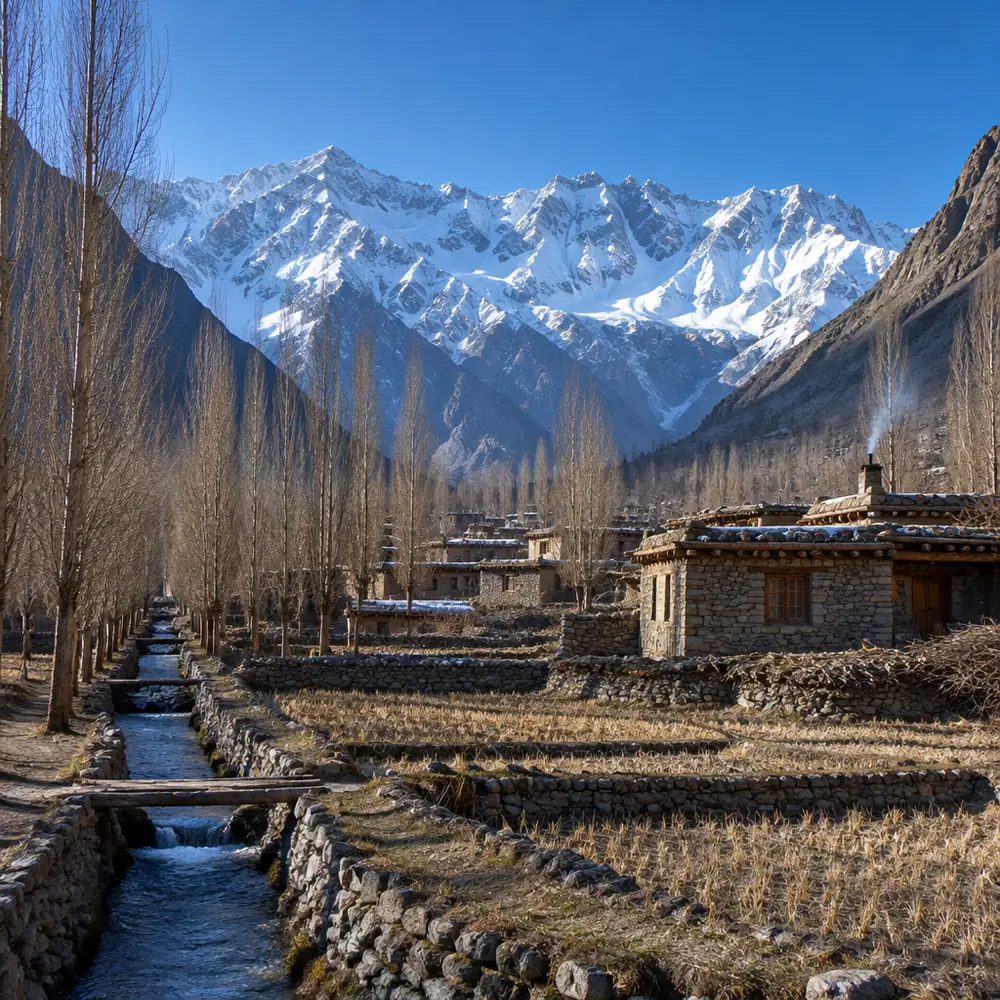
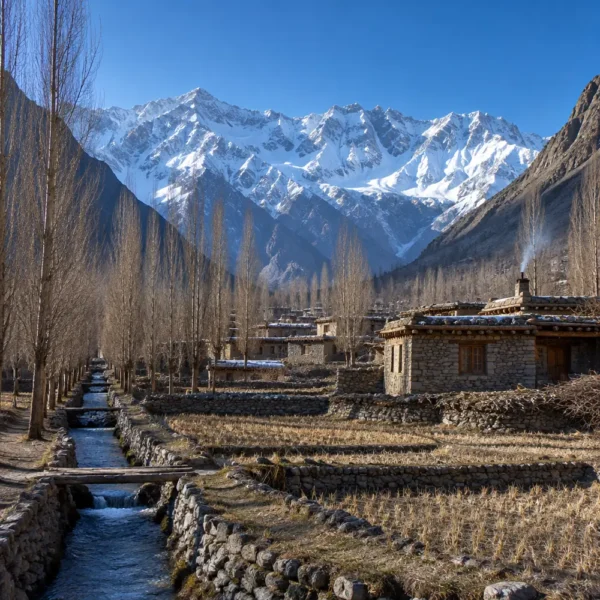
Khaplu is a small town in Ghanche district, roughly 103 km east of Skardu along the Shyok river, and it is the reason a Skardu trip can turn into something better than a Skardu trip. It sits at about 2,600 m with a restored 1840s palace you can walk through, a mosque dated to around 1370, a lattice of stone lanes below the fort, and a valley floor wide enough that the mountains stop feeling like scenery and start feeling like weather. It gets skipped because it is not on the road to anywhere famous: itineraries turn west toward Deosai or north toward Hunza. Khaplu waits at the end of a branch that costs a day, and given what it gives back, that day is cheap.
Where Khaplu Is, and Why It Gets Skipped
Khaplu is the administrative capital of Ghanche, the easternmost district of Gilgit-Baltistan. Historically it was the second-largest kingdom in Baltistan under the Yabgo dynasty, holding the trade route toward Ladakh along the Shyok. That explains the density of the place: a palace, a cluster of old mosques, and lanes built for caravans rather than cars, all in a town you cross on foot in twenty minutes.
It gets skipped because Khaplu is a spur, not a through-route. Groups on a fixed pattern of nights land in Skardu, see the lakes and the dunes, and turn around. Those who go usually asked what was east. Our northern mountain tours are built around adding the second-best-known valley, which is usually the one people talk about afterwards.
The Road from Skardu Along the Shyok
The drive takes two and a half to three hours without long stops, and treat that as a range rather than a promise. Road work, a tea halt, the pace of whoever is driving: all of it moves the number. What does not change is the shape of the journey. You leave Skardu, cross to the north bank, and follow the Shyok east between bare slopes, with villages where a side stream gives them water.
The river is the point of the drive: broad, grey-green and fast, turning up on your left when you least expect it. For the rhythm of long mountain drives, how a guided tour makes the Karakoram Highway easier covers the other great road. Near the end, at Saling, a bridge crosses the Shyok and the view opens toward Masherbrum, which is where the scale of what lies ahead lands.
Khaplu Palace: A Royal House You Can Walk Through
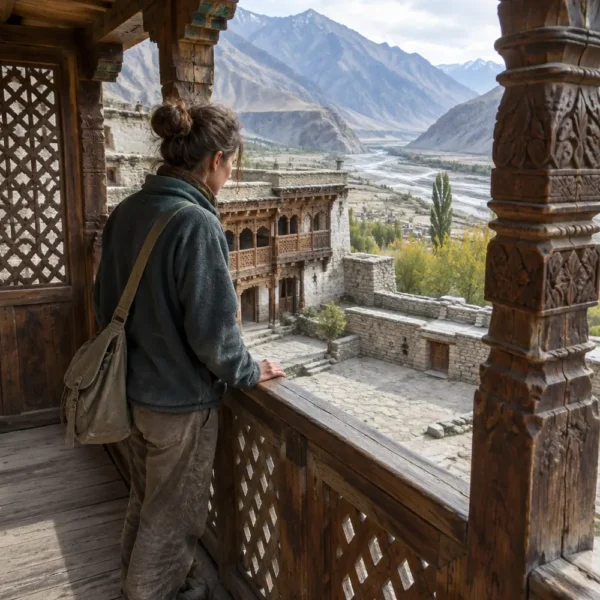
The palace dates from the 1840s and was restored with support from the Aga Khan Trust for Culture and the Aga Khan Cultural Service Pakistan. It now runs as a heritage hotel with a small museum, so the building is not roped off behind glass. You walk in, climb the timber stairs, and end up on a balcony over the courtyard, and the architecture stops being a display and becomes a place to stand.
Look at the joinery while you are up there: balconies, carved railings, shutters, all wood working against stone, built by people who knew a house in Baltistan has to breathe in summer and hold heat in winter. The museum photographs are the interesting part, because they show the same valley with fewer trees and no road. Give it ninety minutes, in the morning if you can. Cultural and heritage tours are where this belongs, rather than squeezed between two lakes.
Chaqchan Mosque and the Wooden Mosques of Baltistan
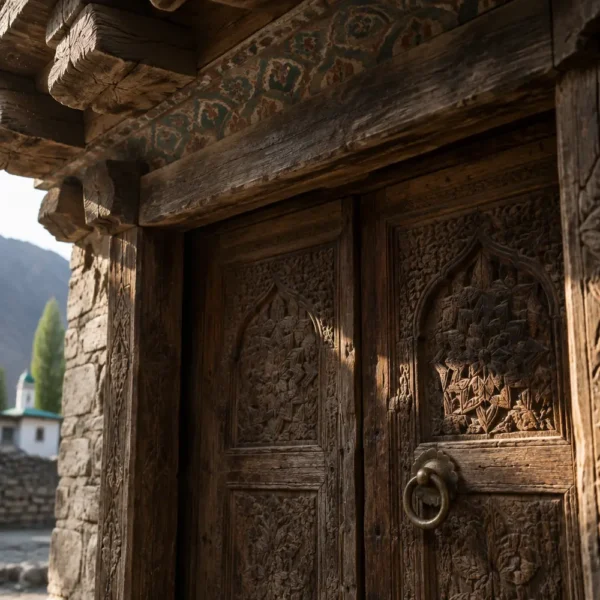
Chaqchan is dated to about 1370 and is traditionally linked to Mir Sayyid Ali Hamadani, making it one of the oldest mosques in Baltistan. It is not a ruin or a reconstruction: it is a working building, low and square, with a carved wooden facade and a doorway worn smooth by six centuries of hands. The carving is geometric and unhurried, and rewards standing close rather than photographing from the path.
Baltistan has a family of these wooden mosques, and Khaplu is a good place to notice how they differ from the Mughal brick and sandstone most visitors see in Lahore. Timber here is scarce and valuable, so it goes where it will be seen: doorways, pillars, beam ends, the frames around the mihrab. Northern Pakistan, valley by valley puts these buildings alongside the ones in Hunza and Gilgit. Dress modestly, take shoes off at the door, and ask before photographing anyone praying.
The Old Town Lanes Below the Fort
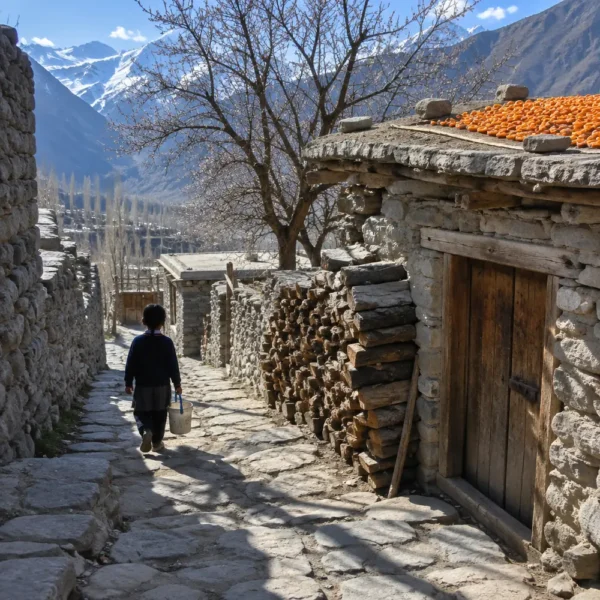
Below the palace and the fort, the old town is a grid of narrow lanes between stone and mud walls, with low wooden doors, stacked firewood, and apricots drying on flat roofs in season. It is residential, not staged, so walk it as a guest in someone’s neighbourhood. A quiet hello, and asking before pointing a camera at a doorway with a person in it, goes a long way.
This is the part of Khaplu a day trip destroys. Arrive at midday and the lanes are bright, empty and slightly shut; arrive at eight and there are buckets, bread going into a tandoor, and children on their way to school. Two nights is what it takes to get the second version.
Khaplu as a Base: The Hushe Valley and the Big Peaks
Khaplu is the last town of any size before the Hushe valley, and Hushe is the approach to Masherbrum, Chogolisa, K6 and K7. That makes the town a base rather than only a destination. Trekkers use it to sort out last supplies and porters; everyone else uses it to look at the mountains from a road instead of a summit.
You do not have to climb anything for the payoff. A day up the Hushe road puts you among fields and glacier melt with the peaks in view, and back in Khaplu for dinner. The best treks in Pakistan sets out which valleys suit which level of fitness.
What the Valley Looks Like Through the Year
April is blossom, with fruit trees flowering through the villages and walking weather that stays cool. From mid-September to October the air clears and the poplars turn. June to August is green and warm but busier, with flatter midday light. Winter is cold, quiet and genuinely beautiful, with snow on the valley floor, though some roads and hotels slow down and a few close outright.
Whatever month you pick, a good day has the same shape: early light on the valley, a building or a lane before the sun gets high, a long lunch, and the afternoon for the side valley road.
A Sensible Shape for Two Nights in Khaplu
Day one: leave Skardu after breakfast, follow the Shyok, stop at Saling bridge, reach Khaplu by early afternoon, then the old town and the palace balcony. Day two: Chaqchan in the morning while it is quiet, then the Hushe road, or a wander through the villages if you would rather not drive. Day three: an early walk in the lanes before the drive west.
Two nights is the minimum that makes the drive worth it. Our 7-day Skardu itinerary shows where a Khaplu night fits without crowding the lakes, and the Deosai, Hunza and Skardu road tour is the version for travellers who also want the west and north in one loop. For the Skardu end, our Skardu travel guide and the most beautiful places in Skardu cover the days either side, and the Hunza valley guide is the honest comparison if you are weighing Baltistan against the north.
What Khaplu Asks of You, and What It Gives Back
It asks for a day of your trip and a willingness to be somewhere without a highlight reel. There is no boat ride, no viewpoint with a queue, no single photograph that sums it up. What it gives back is a town that behaves like a town: a palace you can sit in, a mosque older than most things you have seen, lanes where the morning belongs to the people who live there.
Most people who add Khaplu say they wish they had given it one more night. Our full tour list is where to find a route that already includes it. If you would rather build one around it, message us on WhatsApp at +92 344 7181087 through wa.me/923447181087, or send your dates through the contact and enquiry page.
Questions About Khaplu
How far is Khaplu from Skardu and how long does the drive take?
Khaplu sits about 103 km east of Skardu, in Ghanche district. The road follows the Shyok river for most of the way, so the drive usually takes two and a half to three hours without long stops. Treat that as a range rather than a schedule: road work, a tea stop and the pace of a local driver all move it. Most of our routes give the drive its own morning rather than folding it into a Skardu sightseeing day.
Is Khaplu worth a night, or can I see it as a day trip from Skardu?
It is worth a night, and two is better. A day trip means five to six hours in the vehicle for three or four hours on the ground, which leaves you at the palace in the harshest light and hurrying the old town. Staying overnight puts you in the lanes in the early morning, when the place is quiet and the light on the Shyok is at its best. Every route that includes Khaplu keeps at least one night there.
Do I need a permit for Khaplu or the Hushe valley?
Khaplu town itself is normally reached without a special permit, but arrangements in Gilgit-Baltistan change by season and by valley, and the side valleys beyond Khaplu, including Hushe, are the ones most often affected. Ask us to confirm the current position for your dates before you plan around it, and do not rely on a blog, including this one, for a rule that can change next month.
When is the best time to see Khaplu?
Late March to April for blossom in the villages and cool walking weather, and mid-September to October for clear air and autumn colour on the poplars. June to August is warm and green but busier, and the light is flatter for photography. Winter is cold, quiet and beautiful, with snow on the valley floor, but some roads and hotels slow down and a few close.