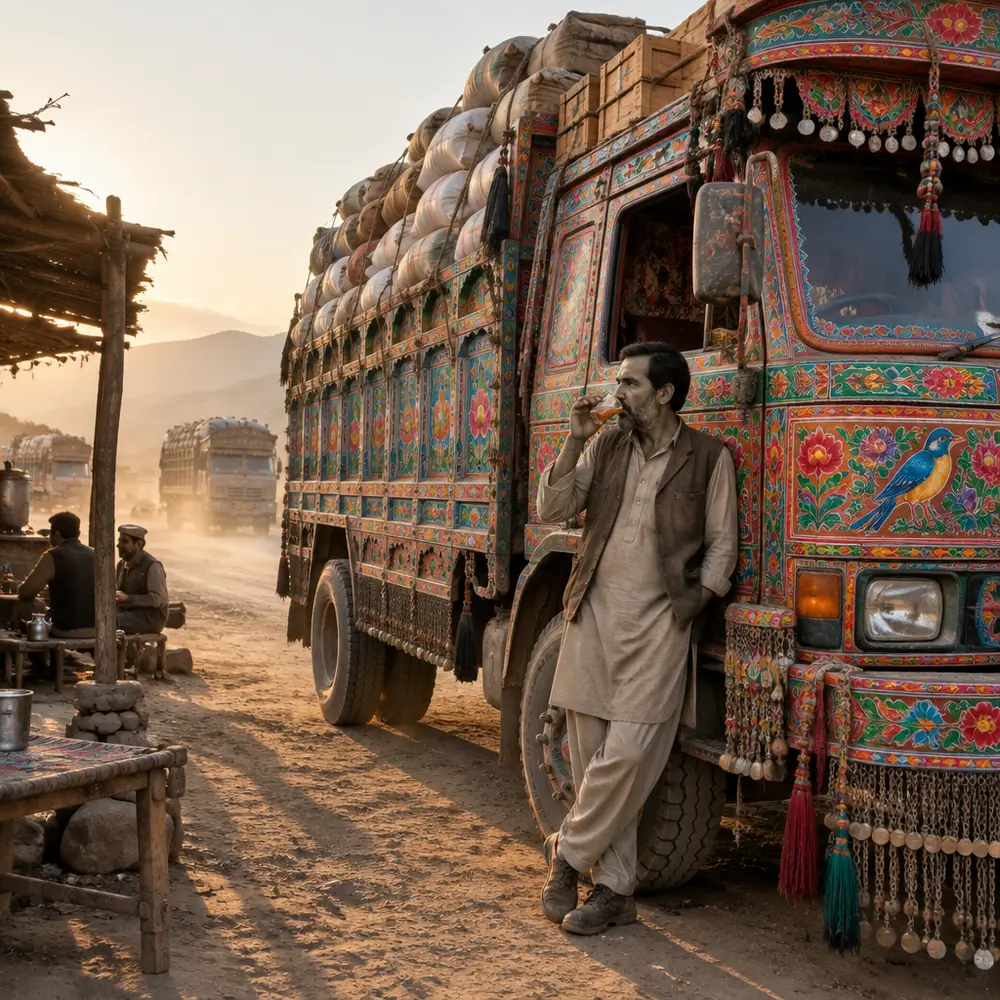
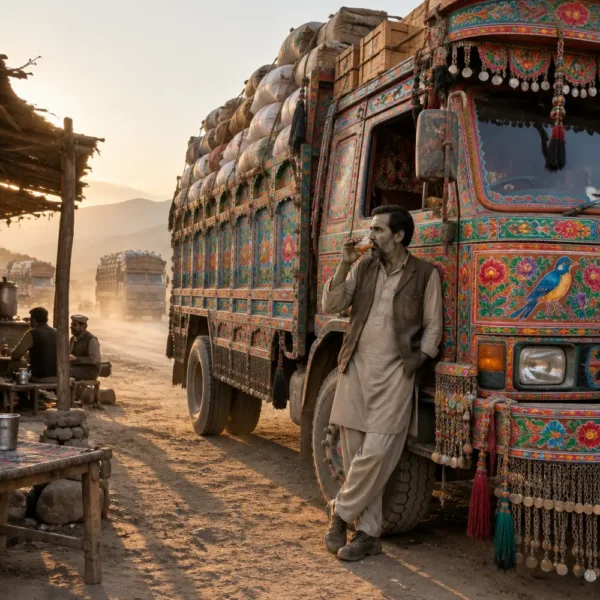
Somewhere on the Karakoram Highway (KKH), which runs from the plains up to the Chinese border, a truck pulls into a roadside dhaba (a simple tea stop) and the forecourt turns into a gallery. The cab is a mosaic of mirrored discs. The flanks carry a painted garden. Chains swing from the bumper, a carved wooden crown sits above the windscreen, and two enormous eyes watch the traffic behind. Truck art in Pakistan is not folk decoration added for tourists. It is a working language, painted and repainted over years, that tells you who owns the vehicle, what he believes, where he drives and what he wants the road to know about him. Learning to read it takes an afternoon, and then a boring highway becomes the best stretch of your trip.
Why Every Truck Is Painted
A long-haul truck here is a family business on wheels. The driver is often the owner, or the owner’s son, and the vehicle is the most valuable thing the family owns after the house. Painting it is partly pride, partly practical: the workshop that lays on the enamel also repairs the bodywork and re-hangs the chains, so decoration and upkeep happen in one visit.
The habit has older roots than most visitors assume, and it sits inside a wider craft culture you can see across our cultural and heritage tours, the same instinct for carved timber and painted plaster that shaped the forts of Pakistan. Bodywork here has long been wood, tin and paint rather than pressed steel, and a decorated vehicle signalled a successful operator before it signalled anything else. Competition between transport firms on the same route pushed the style further: if the truck ahead has a painted eagle, yours needs a bigger one.
There is a religious layer too, and a sentimental one. Verses, calligraphy and the names of saints sit alongside portraits of the driver’s children, film stars and, on older vehicles, the founders of the country. A driver away from home for weeks carries a small piece of it with him, in paint, on the cab.
One practical note: this is a living trade, not a museum piece. Painters work by hand with brushes and enamel tins, and a full repaint is a serious outlay. Pakistani rupees (PKR) are the currency you will be dealing in; at recent rates a thousand rupees is worth roughly three or four United States dollars, so when a workshop owner quotes you a figure for a small panel, divide it in your head before you react.
The Motifs You Will Actually See: Eyes, Birds and Verses
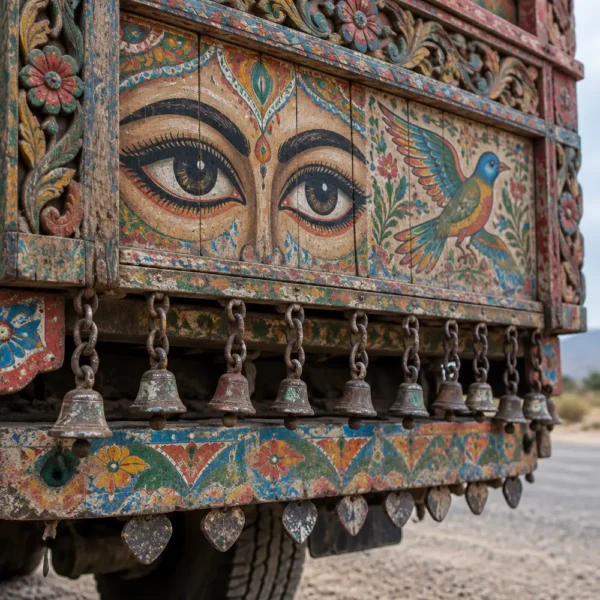
Start at the back. Two large eyes on the rear panel are the most quoted motif in the tradition. Ask three drivers and you get three answers: the truck is awake and watching, it wards off the evil eye, it is simply beautiful. All three are probably true at once. If you want to see this kind of detail in context rather than from a bus window, the cities on our Pakistan cities guide are where the workshops are.
Birds are everywhere, usually in flight and usually paired. Cranes, peacocks and doves carry a general sense of good fortune and departure, which suits a vehicle that is always leaving. Falcons and eagles belong to a harder register and appear most often on trucks running the mountain routes our northern mountain tours follow.
Flowers fill whatever space is left, and the hand that paints a truck often paints the sign above a street food stall. A painter working freehand builds a border of roses, tulips and lotus forms around a central panel, then outlines each petal in contrasting enamel. The flowers are rarely the same twice, even on one truck.
Calligraphy is the part most visitors photograph and least understand. Arabic and Urdu script appears as short verses, blessings and the ninety-nine names of God, and it is treated with care: painters leave these panels clean and rarely overpaint them. When you post a photo, remember this is not ornament. It is text, and people read it.
Then the personal motifs: portraits of children, wedding dates, a village name, a favourite cricketer, a line of poetry in Urdu, the language of the plains. These details turn a painted truck into somebody’s truck.
Chains, Tassels and Chrome: The Parts That Move
What separates Pakistani truck decoration from painted signage anywhere else is that half of it is built to swing. Chains hang in curtains across the rear bumper and along the sides. Tassels of coloured wool or plastic strip dangle from the mirrors and the bumper corners. Metal discs and small bells are bolted on so that they catch light and make noise.
The noise is the point. A loaded truck approaching a blind bend announces itself with bells and clatter long before it is visible, and the moving parts show speed and distance to a driver behind. Decoration doubles as a signalling system, which is why it survives on vehicles that are otherwise falling apart.
Chrome and mirror work does the same job visually. Discs of mirrored plastic are set into the cab in patterns, and on a bright afternoon the whole front of a truck throws light in a dozen directions. Older vehicles use cut glass or polished tin; newer ones use plastic mirror sheet, which is cheaper and lighter. The effect at sunset, when trucks queue at a dhaba and drivers drink chai (tea boiled with milk and sugar) beside the cabs, is why photographers stop on this road at all.
The moving parts are also the most fragile. Chains snap, tassels fade, mirror discs work loose on rough tracks. Drivers repaint the front and re-hang the chains far more often than the sides, because the front is what other people see coming.
Where the Best Work Is, and When to Look
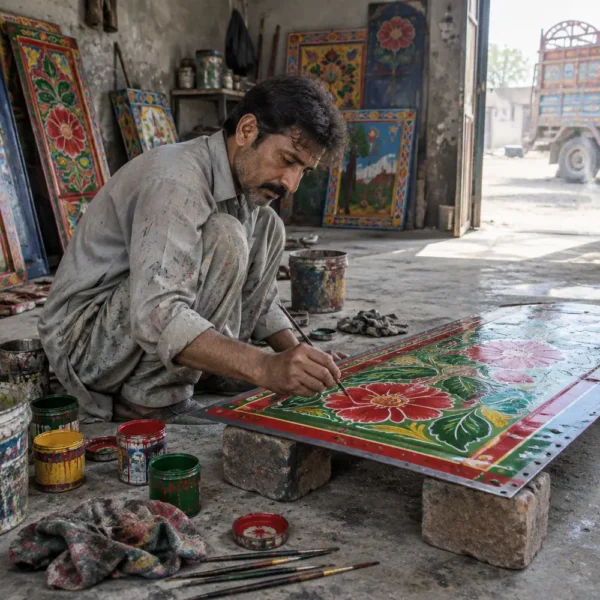
The best truck art in Pakistan is not in the cities tourists fly into. It sits in the workshop towns where transport firms keep their fleets and the bazaars where long-haul drivers stop for the night. Rawalpindi and Karachi have the oldest reputations; Peshawar and Quetta lean on heavier woodwork.
Go where trucks are parked in rows: a transport yard, a body shop, a truck bazaar on the edge of town. Ask at a dhaba where the paint shops are and someone will walk you over; the food there earns its own trip, as our street food guide explains.
Timing matters more than location. Forecourts fill in the last two hours of light, and workshops are quietest after lunch, when a painter is more willing to talk. On the mountain roads the destinations guide shows which valleys you can reach in a day. Sindh runs red and gold with dense mirror work; Punjab is brighter with larger calligraphy panels; on the KKH, dust and altitude thin the flowers and add eagles.
How to Photograph a Truck Without Getting in the Way
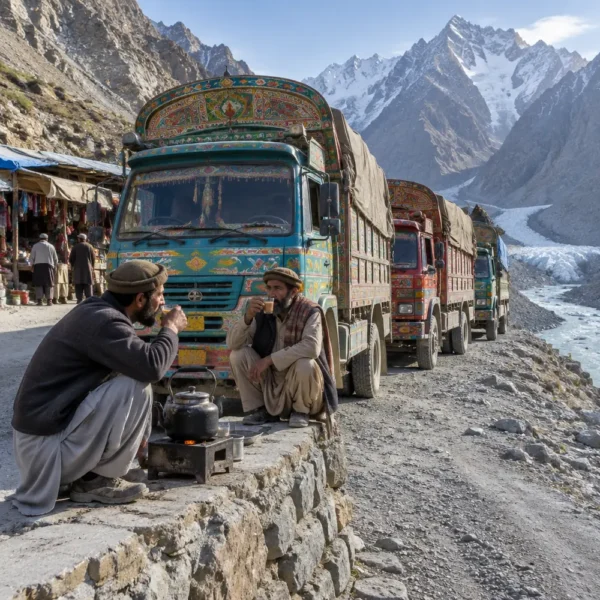
This is somebody’s livelihood and often his home for the week. Ask the driver, not the crowd: a gesture at your camera and a questioning look is enough. A refusal is rare and ends the attempt, and the same courtesy rules that cover the rest of your trip are set out in our Pakistan travel etiquette guide.
Shoot the whole truck before you move in. One square-on frame of the full side records the design; details are easy to find later, the composition is not. Then work the panels: rear eyes, the crown above the windscreen, chains against the light.
Overcast gives even colour with no glare off the mirror discs; low sun makes the chrome explode and the paint glow. At a busy dhaba, stand clear of anything reversing, and never step onto the road for a wider shot. Mirror work fools a light meter, so expose for the paint and let the highlights burn. If you would rather look at finished frames than take them, the photo gallery is where our own best road shots sit.
What the Paint Says About the Driver
Read a fleet and you can guess the trade. A portrait of a small boy beside a wedding date is a family investment, and the driver is likely the father. Dense religious panels with few portraits suggest a man who keeps his devotion public and his family private. A cricketer and a line of Urdu poetry reads younger.
Condition tells you the route. Fresh front panels and re-hung chains mean mountain work; elaborate sides over a tired bumper mean the plains. None of this is a formal code, and drivers will contradict you cheerfully. That is the pleasure: the paint is a conversation the owner is having with everyone behind him.
If you would rather have someone read it with you, in the right bazaars at the right hour, our team plans cultural and heritage tours that put workshop visits and dhaba evenings into a route that works. Tell us what you want to see through our contact page.
Frequently asked questions
Is it rude to photograph a truck without asking?
Yes, ask first. The truck is a workplace and often a home for the week, so a gesture at your camera and a nod from the driver is the minimum. Refusals are rare, and when one comes it should end the conversation.
How much does a full truck repaint cost?
It depends on the vehicle’s size and how much carving and chrome is involved, and prices move with the rupee. Ask a workshop for a figure on the panel you care about; treat any online number as a starting point, not a quote.
Can I buy a painted panel or a piece of truck art?
Small painted items, number plates, chains and mirror work are sold in bazaars and at workshops, and painters often make a small panel to order. A panel cut from a working truck is another matter, and most owners will refuse.
Which city is best for seeing truck art?
Rawalpindi and Karachi have the deepest workshop reputations, while Peshawar and Quetta show strong regional styles. The Pakistan cities guide shows where each sits on a sensible route. Any transport town has painted vehicles; the difference is finding a yard with several parked at once.
Do women own or drive painted trucks?
Long-haul trucking here is overwhelmingly a male trade and the workshops are male spaces, so the paint is almost always commissioned by men. Women travel these roads constantly and are welcome at dhabas and bazaars, though a workshop visit is easier with a guide along.